
Oscar Awards: Best Writing, Original Screenplay
“Juno” presents an original story of teenage pregnancy and how children may deal with this unexpected change. The screenplay opens with the 16 year-old Juno MacGuff offering her best friend Paulie Bleeker to have a one-night sexual relationship on a chair. Out of curiosity and boredom, both teenagers consent to share love. The next day, the young girl feels unusually nauseous, only to realize that she is pregnant. Discussing her pregnancy with her friend Leah, Juno ultimately confesses to her parents about her final decision to keep her child. The brave soul continues to attend school and leaves the child to adoption. A seemingly caring couple Vanessa and Mark Loring willingly accept Juno’s child. However, as Juno visits the Lorings’ house to keep them updated, she notices Mark’s growing attention for her as woman. The teenager cannot fathom this unacceptable behavior and returns to her first love Paulie for support.
The screenplay develops a self-confident, unique teenage girl Juno, a character difficult to encounter in today’s society. Despite the fact that she faces judgements from her classmates, she sets herself as her first priority and stands strong against all of the hate thrown at her. Although the movie is set solely on Juno’s perspective and may appear limited to an immature teenager’s thoughts, the scenes reveal the key distinct characteristics of each character that shape him/her. For instance, Paulie Bleeker is established as a timid cross country player who acts as Juno’s bets friend, when inside, he truly admires her. Bren MacGuff, Juno’s stepmother, scolds the teenager when needed, but is also the most protective mother more than anyone else. In this way, the perspective is not omniscient, but each character is crafted in his/her special way. Strong character development is evident.
Additionally, the story is easily relatable due to its realism. When Juno first becomes aware that she is pregnant, she panics. She attempts to act natural and calm, yet she continuously confers with Leah to settle on a decision. To her classmates, she is an irresponsible, slightly arrogant young adult who proudly strides along the school halls; to the audience, she is an uneasy child. Many will fathom the emotions Juno undergoes, as she is confused about love at times, but also hopes to enjoy her one and only life. Yet, as Juno matures, her attitude of dealing with pregnancy changes. Since she has taken the different path of keeping her child rather than abortion, the teenager begins to feel connections to her own child, acknowledging the responsibilities she has as a temporary mother. These emotions are well-delivered to the audience, and the viewers are forced to overcome these painful moments with the teenage girl.
However, with the tears, also come the laughs. The inappropriate jokes mentioned by Juno added to the realism, depicting the typical life of a teenager. Searching for a couple to raise Juno’s child, Leah discovers a family of five in the Pennysaver, desiring to adopt more children. Juno dismisses this couple, claiming that they are merely “greedy little bitches.” With these short scenes with the two teenagers, more people—particularly teenagers—can relate to both the aggressive language and conversation topics. The children further mock the adult language, drawing a clear line between the difference in thoughts between the young and the old. The adults warn the students to remain “sexually inactive” at least before they are fully independent and mature. Unable to understand the phrase itself, Juno gets tired to using these words, especially after her pregnancy. Thus, the sexual, possibly inappropriate, comments help craft a humorous, amusing movie.
Even better, the ending communicates a clear, direct message, particularly for teenagers caught under a dilemma after an unwanted pregnancy. Briefly, anyone could call the ending a cliche happy ending, similar to that of a princess movie. On the other hand, the resolution of “Juno” brings more meaning and depth to the audience. The story closes with Mac MacGuff’s personal love story and his recognition of true love. After watching the screenplay, the shameful perception of teenage pregnancy alters. The audience members come to realize how a child could be born out of pure innocence and curiosity of two teenagers. It is an inevitable fact that the children were careless and immature, but a child “with fingernails” definitely deserves the rights to live. Hence, the director brings forth a special solution, pro-life, to a common conflict, teenage pregnancy.
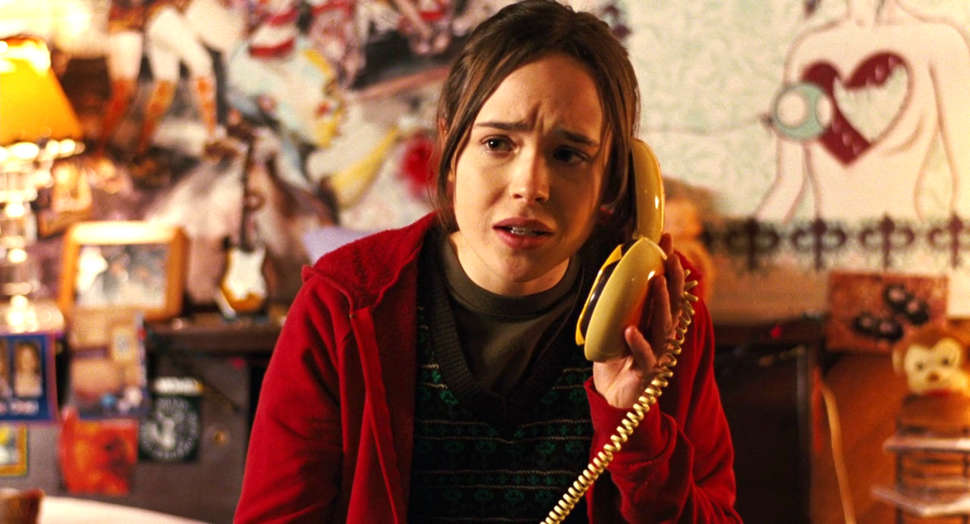
In general, one shortcoming of the screenplay was the lack of the larger response to Juno’s pregnancy. The main reason most teenage mothers cannot give birth to the child and choose abortion is because of the impression pregnancy gives to those in society. The reality is most people glare at a pregnant teenager with pity and disgrace. Pregnant teenagers struggle to adjust back into the unwelcoming society, even as adults. However, the movie does not reveal the setbacks of choosing birth over abortion; therefore, falls short on some realistic aspects. By showing Juno’s fight against the critical public, the movie could’ve gained more authenticity. In other words, the story focuses too strongly on only one aspect of Juno’s circumstances.
Possibly regarded as a fanciful movie, “Juno” conveys a powerful theme of trust and confidence. A teenage girl who believes she’s made an irreversible mistake maturely cleans up the mess with the assistance of her parents. Though disappointed, the MacGuffs encourage Juno’s decision, playing a significant role as supportive guardians. In essence, Juno comes of age and demonstrates how important self-esteem can be. A story that certainly teaches that with no pain, there is no gain.
 A WORKING VACATION
I love this movie! Great review 🙂
LikeLiked by 1 person